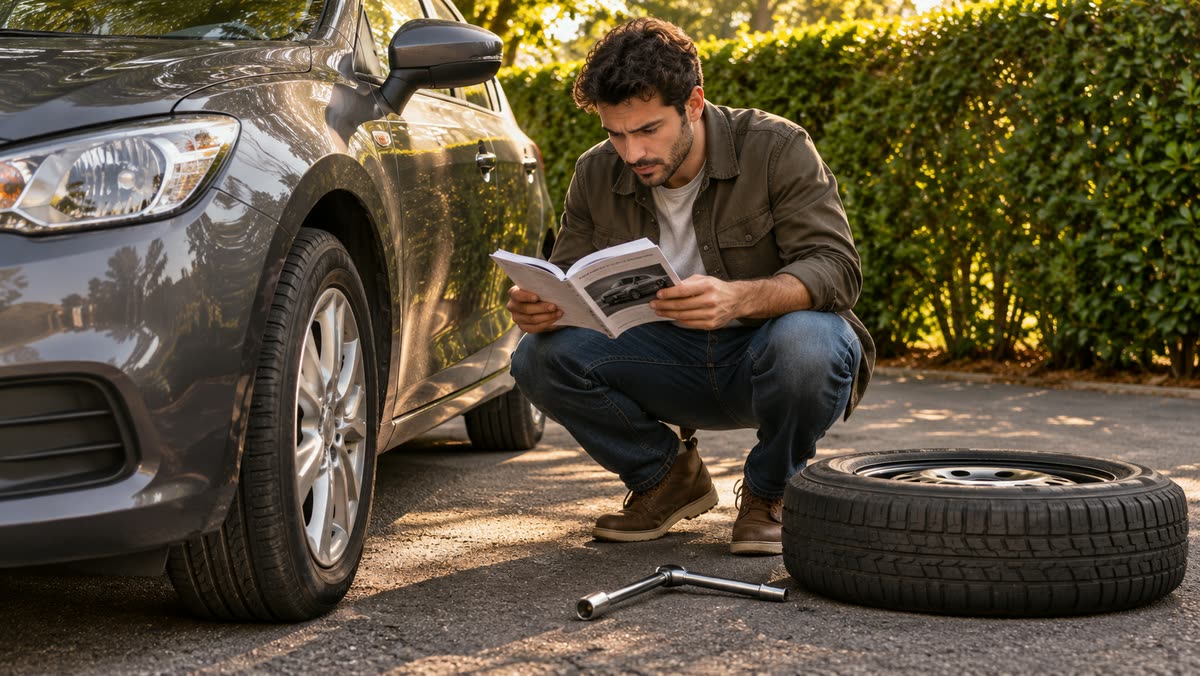
If you get a flat tire, your first job is to reach a safe place. A wide, firm, level area away from moving traffic gives you room to inspect the tire and read the vehicle's instructions. A narrow shoulder, a slope, poor visibility, or soft ground can make a spare change unsafe. Use roadside assistance if you cannot get a stable setup or stay clear of traffic. NHTSA tire safety guidance
Check what your vehicle carries
Find the spare or mobility kit, the jack and wrench, and any key required for locking wheel nuts. Open the tire-change section of the owner's manual for your exact model. It should identify the approved lift points, what to do with the transmission and parking brake, where to place a wheel chock, and the tightening procedure. Some cars use a repair kit instead of a spare. Follow the kit's limitations and call for help if the damage falls outside them.
Check the spare's condition and pressure before relying on it. The pressure for a temporary spare can differ from the road tires. The owner's manual and the tire markings specify the spare's use restrictions. NHTSA also explains how to use the vehicle's tire information label and why the spare needs pressure checks. NHTSA TireWise
Use the manual's sequence on stable ground
- Park in the safe area, switch on the hazard lights, and secure the vehicle exactly as the manual instructs. Keep other people away from the lifting area.
- Identify the correct lift point and lay out the spare and tools. If the manual calls for loosening fasteners before lifting, loosen them only enough to start them turning while the tire is still grounded.
- Position the jack at the approved point. Raise only enough to remove the flat and install the spare. Keep your body out from under the vehicle while it is supported by the jack.
- Start the fasteners by hand and follow the prescribed seating and tightening sequence. After lowering according to the manual, tighten to the specified torque with the appropriate tool. If you cannot verify that the spare is secure, get roadside help before continuing.
These steps give the order of the work. The manual supplies the model-specific placement, torque, and equipment instructions. If a fastener binds, the jack shifts, or the spare does not sit flush, stop and get help. Honda's Civic manual shows how those details are written for a particular vehicle. Honda's 2026 Civic Sedan tire-change instructions
Make the next trip a repair trip
Secure the removed wheel and tools before moving the car. A temporary spare can change handling and braking and may have restrictions on speed, distance, and where it can be installed. Use the instructions for your actual spare. Arrange a tire inspection and restore a normal road tire as soon as practical. Check that the kit is complete and the spare is ready again after the repair.
For example, if you pull into a parking lot and discover the locking key is missing, that is the point to call for help. If the vehicle carries a compatible spare and the manual's lift point is accessible on level pavement, follow that manual with the right tools. The condition of the scene and equipment determines the next step.