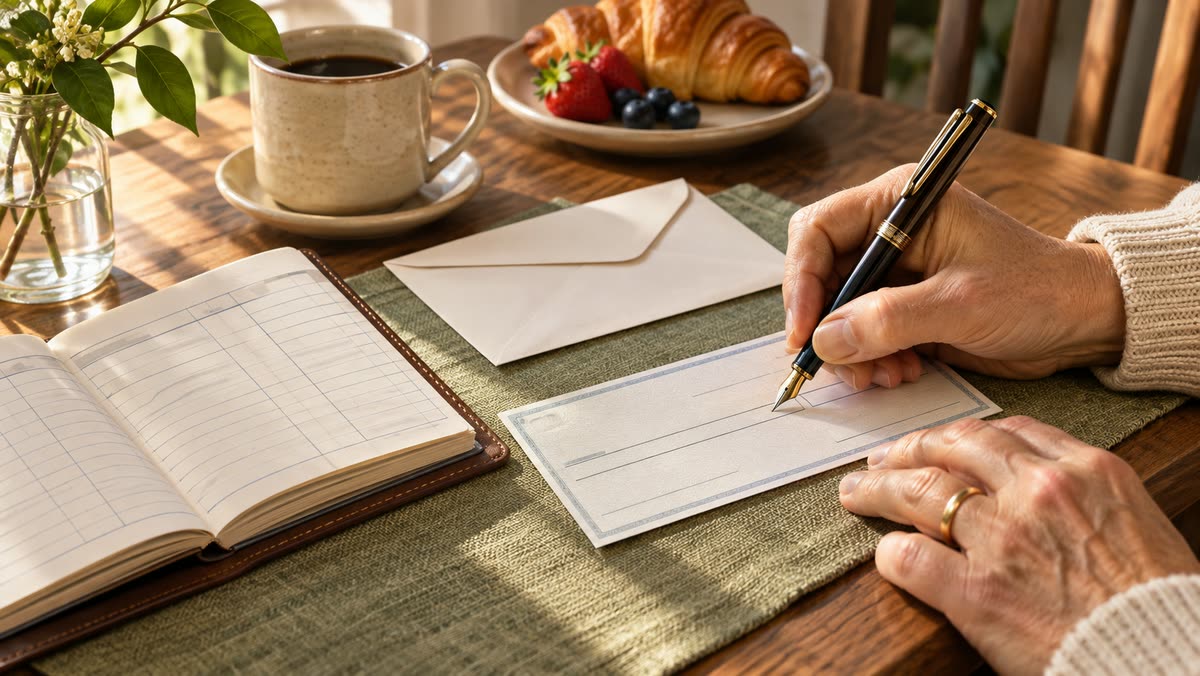
To write a U.S. personal check, enter the date, the recipient's name, the amount in numbers, the same amount in words, and your signature. Put a reference in the memo if the recipient requests one. Check the recipient and both amounts before signing, then record the payment so you can keep the money available until it clears. The example below shows a fictional $125.50 utility bill, including what to write for cents, how to handle a mistake, and what happens to a spending plan while a check is outstanding. The FDIC Money Smart worksheet shows the fields on a sample check.
Fill in the fields in the order you can check them
| Field | Example for a $125.50 utility bill | What to check |
|---|---|---|
| Date | November 14, 2026 | Use the intended date and follow your payment instructions. |
| Pay to the order of | Cedar Street Water Utility | Use the name on your bill, not a description such as “water.” |
| Numeric amount | 125.50 | Keep the decimal and both cents digits clear. |
| Written amount | One hundred twenty-five and 50/100 | Make the dollars and cents match the box. |
| Memo | November water bill | Add a reference or invoice number only if appropriate. |
| Signature | Your usual signature | Sign after you verify the other fields. |
If the word “Dollars” is already printed at the end of the amount line, write the amount before it. A line through the remaining unused space can make an addition more obvious. Keep the entry comfortably within the available space without covering printed information. You do not need to write the currency symbol twice when it is already printed next to the number box. Use a fresh check if you cannot read what you wrote or if you entered the wrong payee or amount.
For $125.00, write “One hundred twenty-five and 00/100.” For $125.05, write “One hundred twenty-five and 05/100.” Five cents takes a zero before the five in the numeric box as well. For $1,025.75, write “One thousand twenty-five and 75/100.” When the recipient provides an invoice reference, copy it exactly. The memo can help the office route the payment; it does not replace a correct payee or amount.
Check the recipient and amount before you hand it over
Read the amounts aloud as dollars and cents. A box that says 125.50 and a line that says “One hundred fifty-two and 50/100” describe different payments. Make a fresh check for the correct amount and note the spoiled check number as void in your own records. A wrong payee name is also worth rewriting rather than asking an employee at the recipient's office to interpret it. Do not leave a signed check with a blank name or amount.
For a payment by mail, check the address and reference against the actual bill. A payment office can use a different address from the company's general mailing address. If it asks for a payment slip, put the slip with the check before sealing the envelope. Check whether the due date refers to receipt rather than mailing, and allow enough time for delivery and processing. Use the recipient's verified service number to ask about faster accepted options if the due date is close. Retain the check number, amount and sent date without unnecessarily circulating an image of your account details.
Reserve the money until the payment clears
Imagine your bank shows $500 and you mail the $125.50 check. If that balance does not yet reflect the check, your own available amount before other commitments is $374.50. Now suppose a $45 purchase is still outstanding and is also absent from that $500 balance. Your planning figure becomes $329.50. A payment shown as pending may already be reflected in an available balance. Check what that balance includes before subtracting the amount again.
| Moment | Balance shown in this example | Items not yet reflected | Amount to plan with |
|---|---|---|---|
| Check mailed | $500.00 | $125.50 check and $45.00 purchase | $329.50 |
| Purchase posts first | $455.00 | $125.50 check | $329.50 |
| Both payments post | $329.50 | None of these two | $329.50 |
Make a register entry with the check number, recipient, date, amount and status. Reconcile it when the matching withdrawal appears. If an image is available, use the number and amount to identify the entry. If the check has not appeared by the time you expected, ask the recipient about its status. Do not assume the money is free to spend simply because a few days passed. You can enter the check as a one-time outflow in the Pay & Bill Calendar and give it a conservative date based on when the money should be reserved, as long as you do not also deduct it from the opening balance. The CFPB budgeting toolkit offers bill calendars and cash-flow worksheets for the same habit.
Handle a lost, returned, or already deposited check
If you still have a spoiled check, record its number as void and keep or dispose of it according to your own record practices. If you already handed over or mailed a check and it might be lost, contact the bank through a verified number. Have the check number, payee, amount and approximate date at hand. Ask whether it has cleared, what a stop-payment request can do at that point, and about timing, fees and expiration. The CFPB stop-payment guide explains why the timing of your request matters.
Tell the recipient you are checking the original before paying again. Keep a record of the next step you and the recipient agreed to, and ask whether the payment deadline or any late charge needs attention. Do not assume writing “void” in your register cancels a check someone else has. If the bank says it already paid the item, ask for the image and the bank's process for reporting an unauthorized or altered payment. If a legitimate payment was returned, ask both parties what failed before sending a replacement.
Make a repeatable two-minute check
Keep the bill, check and register together while filling in the payment. Match the recipient, match the amount in both places, and verify the due date and destination. Sign once you are satisfied. Put the check number in your own record and reserve the amount. When the recipient confirms delivery, leave the entry outstanding until your bank shows that it cleared or you have confirmed another resolution. That routine is more useful than remembering a set of fields and hoping the balance shown on your phone has caught up.