Start with the decision your plan needs to support. A plan for a lender needs the information the lender requests. A plan for testing a new offer should tell you what to sell, to whom, how to reach them, and how much you can spend finding out whether they will buy. You can start with a page and expand the parts where a reader needs more evidence. The SBA explains lean and traditional formats and what each usually covers. SBA business plan guidance
Write six sentences before making projections
Write one sentence for each of these questions. Who is the customer? What problem do they already spend time or money solving? What will you offer at what price? How will a customer find and buy it? What will it cost to deliver each sale? What evidence would change your mind? Use language that can be tested. “A $12 lunch collected near an office by noon” gives you a price, location, and delivery condition. “Premium convenience for everyone” leaves all three open.
For a hypothetical lunch service, start with office workers in two nearby buildings and a preorder deadline the day before pickup. Check what they buy now, how much they pay, and what prevents them from ordering ahead. Run a small trial with a capacity you can serve. Record paid orders, repeat orders, cancellations, and discarded portions. Those observations belong beside the forecast.
Calculate the sales volume that pays the bills
Assume a $12 price, $5 in variable costs per meal, and $2,100 in monthly fixed costs. Each sale contributes $7 toward fixed costs. Dividing $2,100 by $7 gives 300 meals per month, or 15 per selling day across 20 days. In your own plan, include the costs that change with each order, including packaging, payment processing, delivery, or labor when applicable. SBA startup cost and break-even resources
| Monthly volume | Sales | Variable costs | Amount left after fixed costs |
|---|---|---|---|
| 200 meals | $2,400 | $1,000 | −$700 |
| 300 meals | $3,600 | $1,500 | $0 |
| 400 meals | $4,800 | $2,000 | $700 |
This simplified operating example excludes costs outside the assumptions, such as financing and taxes. If the $5 per meal rises to $6, contribution falls to $6 and break-even rises to 350 meals. Check whether your kitchen capacity and pickup window can handle that change. The model is most useful when it reveals a decision, such as reducing waste or limiting a delivery area.
Keep cash timing beside profit
Suppose your first supplies and packaging cost $600 this week but prepaid orders come in next week. The plan needs enough starting cash for that gap even if the sales are profitable. List the dates when rent, inventory, equipment, and customer payments hit the account. Keep startup purchases apart from recurring fixed costs. Use the Cash Flow Planner to check a short calendar, then put the key assumptions beside your financial forecast.
Turn the draft into a decision
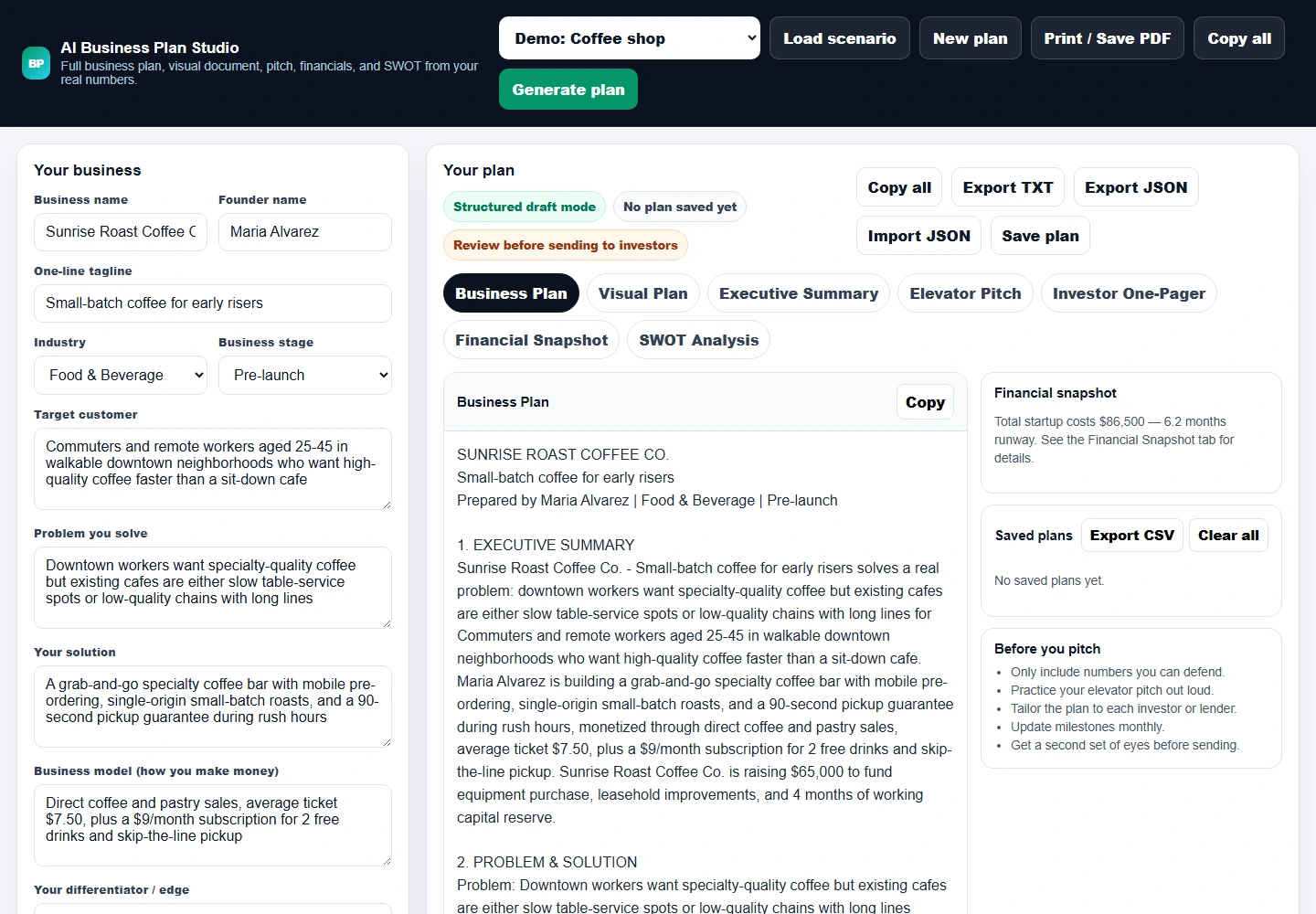
Give each uncertain line an owner, a source, and a date to check it again. If you are applying for funding, match the requested format and show how the amount will be spent. If you are testing demand, choose a volume target and a decision date before committing to a larger expense. Calcoras offers a tool for organizing inputs into a draft, investor one-pager, and financial snapshot. Check the numbers against your own model before using the output. Calcoras AI Business Plan Studio